Public data · Information design · AI
Who decides what Wikipedia deletes
Wikipedia says that deleting an article is "not a vote," so I mapped about 382,000 deletion debates from 2005 to 2018 to see who holds the power and which arguments end up winning.
- Role
- Independent project: data pipeline, analysis, design and code
- Methods
- Python, Sentence embeddings (all-MiniLM-L6-v2), Leiden clustering, UMAP layout, Claude Haiku for decision pathways, MapLibre GL
- Year
- 2026
The question
Wikipedia is built through collective knowledge and decision-making, but a much smaller group could shape what knowledge stays in it. When an article is nominated for deletion, editors debate it, and then an uninvolved editor or administrator closes the debate and decides. Wikipedia is explicit that this is “not a vote,” so I wanted to know who actually holds the power and which arguments end up winning.
What I built
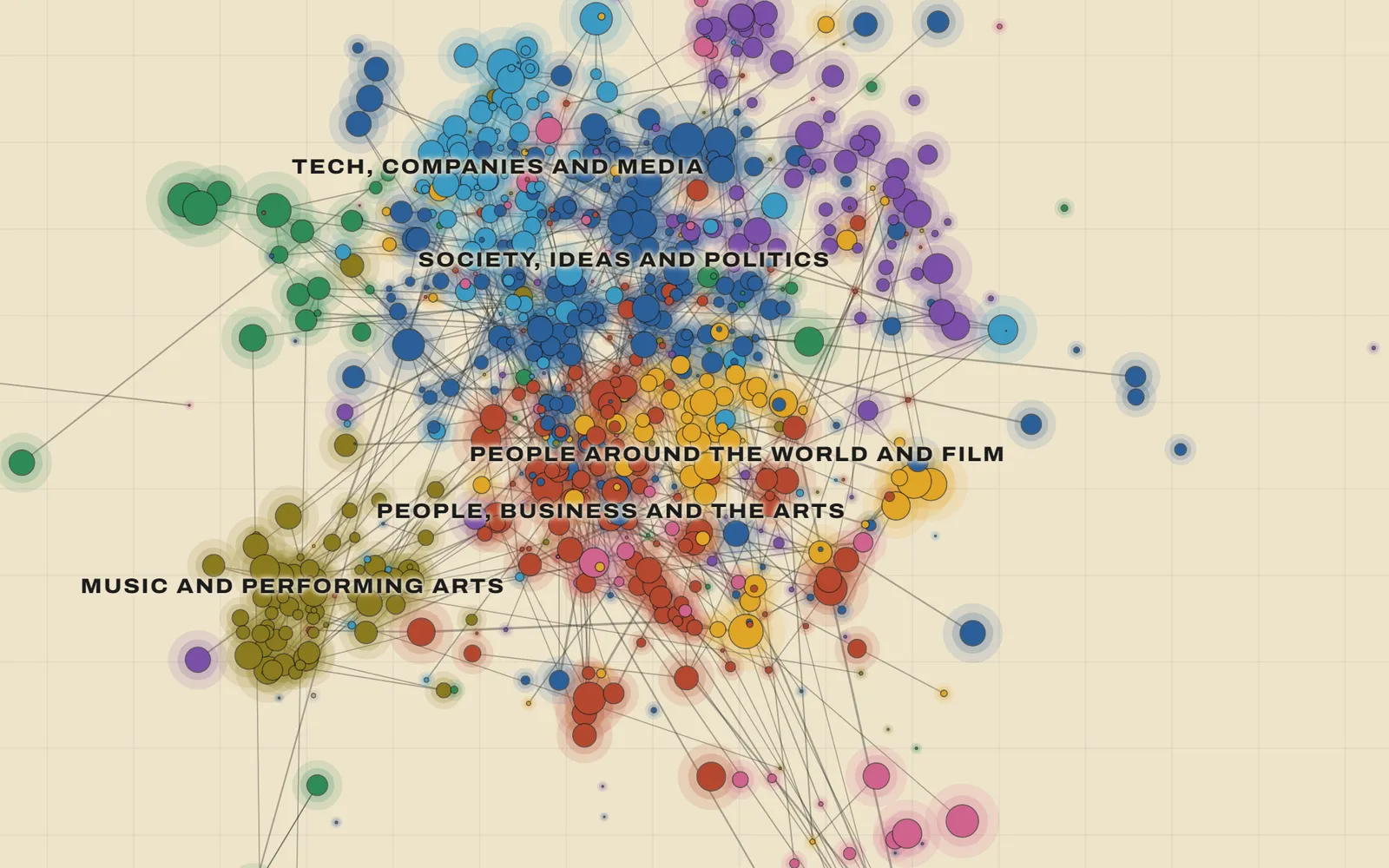
I used every Articles for Deletion debate in the Cornell ConvoKit corpus, about 382,000 of them from 2005 to 2018. Each debate is a dot, and debates where editors made similar arguments sit close together, so the map groups into topics like music, sports and companies. You can zoom from broad topics all the way down to a single debate and read who nominated it, who argued what, and who closed it.
For 1,941 of the most contested debates, I used AI to build a decision pathway, which groups the arguments into boxes and shows how they answered each other on the way to the decision. Every point in a pathway has to cite a real comment from that debate, and the pipeline drops any pathway that doesn’t, because a summary is only useful if it traces back to something an editor actually wrote.
What I found
Closing power is concentrated. Across all 382,020 debates from 2005 to 2018, 3,820 people closed at least one, but just 52 of them closed half of all debates. When most editors took the same side, the outcome went their way 96% of the time, so the open question is less about whether closers overrule editors and more about who decides in the close calls.